Live cricket score update

Saturday, September 24, 2011

Do neutrinos move faster than the speed of light?

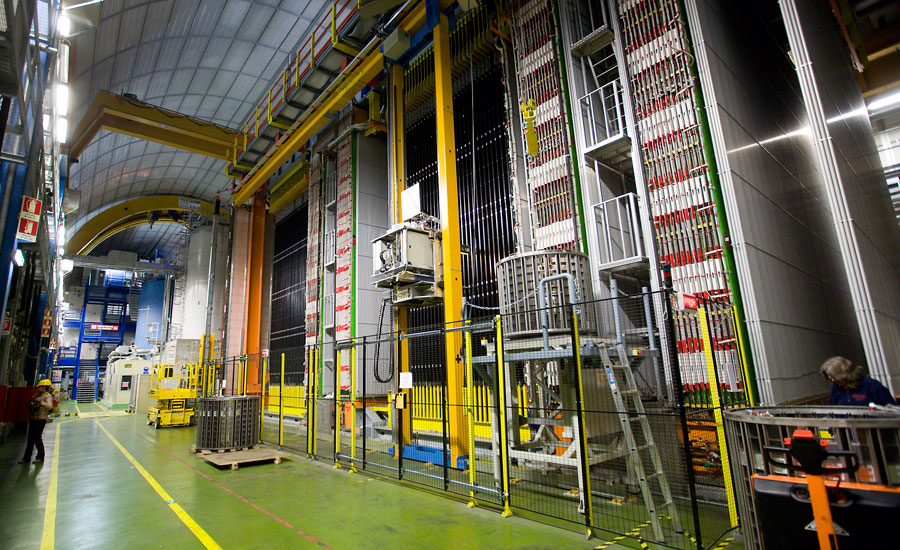
The OPERA detector

Can particles travel faster than the speed of light? Most physicists would say an emphatic "no", invoking Einstein's special theory of relativity, which forbids superluminal travel. But now physicists working on the OPERA experiment in Italy may have found tantalizing evidence that neutrinos can exceed the speed of light.
The OPERA team fires muon neutrinos from the Super Proton Synchrotron at CERN in Geneva a distance of 730 km under the Alps to a detector in Gran Sasso, Italy. The team studied more than 15,000 neutrino events and found that they indicate that the neutrinos travel at a velocity 20 parts per million above the speed of light.

Simple measurement

The principle of the measurement is simple – the physicists know the distance travelled and the time it takes, which gives the velocity. These parameters were measured using GPS, atomic clocks and other instruments, which gave the distance between source and detector to within 20 cm and the time to within 10 ns.
This is not the first time that a neutrino experiment has glimpsed superluminal speeds. In 2007 the MINOS experiment in the US looked at 473 neutrons that travelled from Fermilab near Chicago to a detector in northern Minnesota. MINOS physicists reported speeds similar to that seen by OPERA, but their experimental uncertainties were much larger. According to the OPERA researchers, their measurement of the neutrino velocity is 10 times better than previous neutrino accelerator experiments.

'Totally unexpected'

"This outcome is totally unexpected," stresses Antonio Ereditato of the University of Bern and spokesperson for the OPERA experiment. "Months of research and verifications have not been sufficient to identify an instrumental effect that could explain the result of our measurements." While the researchers taking part in the experiment will continue their work, they look forward to comparing their results with those of other experiments so as to fully assess the nature of this observation.
Although a measurement error could be the cause of the surprising result, some physicists believe that superluminal speeds could be possible. Its discovery could help physicists to develop new theories – such as string theory – beyond the Standard Model of particle physics. However, the OPERA measurements will have to be reproduced elsewhere before they are accepted by the physics community.
Jenny Thomas of University College London, who works on MINOS, said "The impact of this measurement, were it to be correct, would be huge. In fact it would overturn everything we thought we understood about relativity and the speed of light."
Alexei Smirnov, a high-energy physicist at the Abdus Salam International Centre for Theoretical Physics, Italy says he finds the OPERA result “extremely surprising” as while some small deviation could have been expected, the observed deviation is very large - much larger than what is expected from even very exotic theories. “If this result is proved to be true, the consequences for modern science would undoubtedly be enormous,” he says. He agrees with conclusion of the OPERA collaboration that currently unknown systematic effects should be looked for and they should continue observations. Smirnov was one of three researchers who discovered the “matter-mass” effect that modifies neutrino oscillations in matter.

Talking about neutrinos

On Friday afternoon, OPERA researcher Dario Autiero from the Institut de Physique Nucleaire de Lyon discussed the details of their experiment at a seminar at CERN. Autiero addressed possible reasons for their result that took into consideration everything from inherent errors during calibration of clocks, to tidal forces and the position of the Moon with respect to CERN and Gran Sasso at the time of the readings.
They considered the possibility of problems internal to the detector itself, the chances of which OPERA say were reduced thanks to the independent external calibration methods they used. They also discussed if it would be possible to re-create the results at different energies. “We don’t claim energy dependence or rule it out with our level of precision and accuracy” said Autiero. The final note of the seminar seemed to suggest that the real reason is indeed a mystery for the time being and further analysis will definitely be required.
The discovery is described in arXiv:1109.4897 (PDF).

Saturday, July 23, 2011

No Link Yet Between Cellphone Use And Brain Tumor

Another new studies that could not find any link between prolonged cell phone usage and brain tumors.

Y'know, people can make many speculative arguments back and forth on the issue of cell phone use and brain cancer. The FACT that we have right now are:

1. no established and clear link between cell phone and cancer, and
2. no physical mechanism for cell phone signals to cause cancer.

These are what we have currently. While people certainly are free to exercise caution if they want to, one should not confuse personal preferences and speculation with hard, valid evidence.

I'm more worried about drivers who use their cellphones while driving than I am about the cellphones causing cancers. If people are SO worried about their safety, why aren't they up-in-arms about that? There are enough documented evidence of accidents (including fatal accidents) that were direct results of using cell phones while driving. Instead, we get MORE publicity out of something that hasn't even been well-established, AND people who seem to already believe in them.

Makes no sense....

Tuesday, June 21, 2011

Atom Watch

It’s time to ponder the little things

When we look at the amazing brick sculptures of Nathan Sawaya, we gasp when we hear about exactly how many bricks (and hours!) are involved in building them. All those teensy bricks build up into something amazing, much like a bazillion atoms have built up into YOU.
The building block of matter is now available in swanky wristwatch form. The three-dimensional design represents each component of the atom; the nucleus of protons and neutrons, the orbiting electrons, the trajectory path of the orbiting electrons. The hour and minute hands follow the path of the orbiting electrons. The second hand originates from the Atom’s nucleus; perfect for pondering matters of time and space.Atom’s hour and minute hand has a luminous finish for ease of telling time.

Monday, June 6, 2011

3D TV without glasses


Liquid-crystal displays that let viewers watch images in 3D are the latest success story in the electronics industry – the only problem being that special spectacles are required. But, as Jonathan Mather explains, liquid-crystal technology is also ideal for "glasses-free" 3D displays
"Wow, that's amazing" was at least one visitor's reaction to last year's Summer Science Exhibition at the Royal Society in London. Their enthusiasm was not primarily due to the presence of the Queen, who had earlier opened the exhibition as part of the society's 350th anniversary celebrations. Rather, their excitement was down to the latest liquid-crystal displays on show from Sharp Laboratories in Oxford. Viewers were able to watch moving images in 3D on a laptop – without the need for special glasses. They could see pigeons being fed in St Marks Square, Venice, with the birds apparently descending from their shoulders, or they could indulge in a 3D adventure as they pursued the bad guys in the interactive computer game Quake.
The glasses-free 3D display on show at the Royal Society was just the latest example of the revolution wrought by liquid-crystal displays, which now allow moving images to be viewed on everything from mobile phones and 46-inch flat-screen televisions to hand-held personal electronic games and the iPad and other tablet devices. Yet it is amazing to think that it is only 40 years since the key patent was filed that marked the birth of the modern liquid-crystal display – a technology so successful that its acronym, LCD, is instantly recognized even by non-scientists. Although organic light-emitting diodes (OLEDs), plasmas and "electronic ink" are also changing the nature of the modern display, it is the remarkable properties of liquid crystals that are now at the forefront of 3D display technology.

Imaging in 3D

Watching images in 3D without glasses is a truly astounding experience, but let's first look at how this fits in with other 3D imaging techniques. There are three main techniques – stereoscopic, holographic and volumetric – all of which operate on the same principles regardless of whether the screen uses liquid crystals, plasmas or OLEDs. They each have advantages and disadvantages in terms of realism, complexity, size and cost, but the most commercially viable method, which is used in the bulk of the 3D televisions taking the high street by storm, involves showing a different perspective of an image to each of our eyes. This "stereoscopic" technique mimics the real world, where each eye sees a different perspective and the brain "fuses" the two images together to create a 3D perception of the surroundings (figure 1a).
The task of separately displaying images to the left and right eye has been tackled in a variety of ingenious ways over the years. Trialled at cinemas as far back as the 1950s, the approach that many people will be familiar with involves the user wearing glasses with separate red and blue coloured lenses on the left and right eye, respectively. The idea here is that an image is split into red, green and blue channels, with the left eye seeing only the red image and the right eye seeing only the green and blue images.
More recent systems do away with coloured lenses and instead use glasses that alternately transmit and block light to each eye. In other words, the lenses act as "optical shutters" so that at any one moment one eye can see a still image, but the other cannot. If we label the successive still images of a movie L1, R1, L2, R2, L3, R3 and so on, then the left eye sees only the "L scenes" and the right eye sees only the "R scenes". These glasses require various bit of electronics to make them work, while the scenes themselves are updated at frequencies of typically 120 Hz or 240 Hz. (An alternative approach – common with projection screens found in pubs to watch sport on – is for the L and R scenes to be displayed with different polarizations, which requires the user to wear dark glasses containing lenses with different polarizations.)
The images produced using this stereoscopic approach can jump out of the screen with surprising realism. However, stereoscopic images are not perfect because all objects in them are in focus, regardless of their intended 3D position. In the real world, in contrast, different depths of a 3D image are in focus at different positions. One technique for creating 3D images that does deal with focus correctly is holography (figure 1b). Holograms are created by recording in a photosensitive material the interference pattern created when coherent reflected light from an object overlaps with a coherent reference beam of the same wavelength. The pattern is stored as a change in absorption, refractive index or thickness of the photosensitive material and a copy of the object can be recreated by illuminating the pattern with a read-out laser. A 3D hologram is essentially like having a stack of high-resolution 2D pictures, where each picture represents a different image plane.
The big advantage with a 3D hologram is that a viewer's perception of three-dimensionality is total because to change from looking at an object near the front of the scene to an object at the back, the viewer needs to adjust their eyes' focus. Unfortunately, creating and controlling optical wavefronts with sufficient precision to generate realistic holographic images requires displays with pixel densities typically thousands of times higher than are found in today's commercial LCDs, as well as prodigious amounts of computer processing power to handle the volumes of data needed. So although their images are superior, further technical innovation is still required before holographic displays become a commercial reality.
Stereoscopy, in contrast, relies on the fact that our brains are good at deducing depth from our right and left eyes having different perspectives of an image. In practice this means that a stereoscopic display can create a 3D image using only twice the amount of data that a "normal" display needs to make a 2D image, which is why they are proving so commercially promising.
The third approach to making 3D displays is to do away with conventional 2D pixels arranged in a plane and instead use 3D, volumetric pixels, or "voxels". One way of creating such voxels is to use projectors shining at a spinning screen (figure 1c). By synchronizing the projectors with the screen, light can be reflected off the screen at any position within the cylindrical volume that it sweeps out. Although volumetric displays can create a strong 3D impression, one snag is that the light projected into the volume of the display is free to propagate throughout this space. This can make items transparent, with objects supposedly hidden behind others tending to "shimmer through" those in front. Volumetric displays also tend to be fairly bulky.

Glasses-free stereoscopy

So far we have described glasses-based stereoscopic 3D displays, but what everyone wants is to do away with the glasses altogether. This is an active area of research being pursued by probably every major displays company and from which new consumer products are now starting to emerge. Nintendo, for example, has already released its glasses-free Nintendo 3DS games console, while 3D mobile phones are available from Sharp.
All such glasses-free displays are based on stereoscopy and the challenge is to ensure that different images are directed to each eye. There are three main methods of achieving this, each of which has its own advantages and disadvantages depending on what it might be used for. The most common approach is where the user has to sit in a fixed position in front of the screen, and this is used, for example, on the Nintendo 3DS, Sharp's LYNX 3D SH-03C mobile phone and in the display on the back of Fujifilm's W3 3D camera. The next approach involves the display tracking the viewing position of the user, and although there are currently no products using this currently on the market, prototype designs have been shown at industry exhibitions in recent years. The final tack is "multi view", which is already found in some glasses-free 3D televisions, although they have not made big inroads into the market as yet partly because it is not easy to generate multi-view 3D without changing broadcasting standards.
The "fixed-position" method assumes that the user views the display head-on so their gaze is at 90° to the display itself (figure 1a) – an assumption that is valid for most mobile devices. The image is separated into tiny stripes L, R, L, R, L, R, with all the L images being sent to the left eye and all the R images being sent to the right eye by means of a physical device known as a "parallax barrier" (figure 2). This technique, which has been known for almost 70 years, could of course be applied to any images – be they photos or paintings – not just an LCD display, provided of course that the left and right images can be interlaced into left and right image stripes to work with the parallax barrier.
A disadvantage of the parallax barrier is that because each eye is allowed to see only half the pixels, light travelling in the "wrong" direction – i.e. from an L stripe to the right eye or from the R stripe to the left eye – is absorbed by the barrier. This cuts the intensity from the display by about half and reduces the resolution. In practical terms, this means that when the display is being used in conventional 2D mode, the parallax barrier should be removed. In most 3D displays, such as Sharp's 3D mobile phone, this is achieved by making the barrier from a liquid-crystal layer that can be turned on or off electrically.
It would of course be much more efficient to dispense with a parallax barrier and instead use lenses, which are transparent, to redirect the L and R light to the appropriate eye. Indeed, researchers have already developed high-quality cylindrical lenses using liquid crystals that can do just that. The principle is simple: as the refractive index of liquid crystals varies with voltage, lenses made from these materials can be turned "on" when a voltage is applied and "off" when the voltage is removed. These cylindrical liquid-crystal lenses take the place of the parallax barrier, redirecting the light in the correct direction (figure 3). This technology is likely to double the efficiency of glasses-free 3D displays in the future, with many companies known to be actively carrying out research into them.
One drawback of parallax technology is that the user has to sit in a certain position relative to the screen. The "tracked viewing position" technique, in contrast, allows 3D screens to be viewed without glasses from any angle by tracking the user's head position. This could be achieved by, for example, fitting a laptop with a forward-facing web camera to identify the location of the user's face and eyes. Indeed, this technology is already common in many digital cameras sold on the high street to ensure that a face automatically becomes the centre of focus. All that is then needed for glasses-free 3D viewing is an automatically adjustable parallax barrier that can change the angle at which the left and right images are seen. The camera can then identify the position of the user, while the parallax barrier directs the left and right perspectives at the appropriate angle.
This adjustment can be carried out using face-tracking algorithms written onto image-processing chips, which operate very efficiently, meaning that not too much processing power is required. The camera can also monitor how far a user is sitting from the screen and adjust the images accordingly. In practice, the viewer can move up to 30 cm from the ideal viewing distance, while their side-to-side movement is limited to about ±30° from the normal. Accommodating more than one user is in principle possible, but the complexity of the system is significantly increased. In addition to the viewer being free to move around, the other advantage of the tracked-viewing-position system is that if the image happens to be from a computer-generated scene, the viewpoint could be adjusted according to the user's position. For example, a viewer could literally look around the side of an object (a cube say) to bring previously unseen faces of it into view.
As for the third method for generating glasses-free 3D – multi-view – its goal is to work with a wide range of viewing positions and multiple viewers. To do this the display outputs not just two perspectives but typically eight or more. The user can then position their eyes to see perspectives 1 and 3, or 2 and 4, etc, so the 3D effect can be achieved from a wide range of angles. A multi-view system with, say, eight views requires eight times greater resolution than a 2D system, and some ingenuity is required to synthesize the eight views or transmit them in the available television bandwidth. Nevertheless, this technology is probably the strongest contender for glasses-free 3D television, with Philips and Toshiba both having already launched a multi-view television onto the market.

Fast forward

As we have discussed, Sharp has already designed and built a liquid-crystal screen on one of its mobile phones that functions as a switchable parallax barrier. Used in tandem with a conventional liquid-crystal display provided with stereoscopic input data, this system gives high-quality glasses-free 3D images. However, the electronic media industry has a vision of the future in which 3D displays are not just a niche product but an integral part of modern life. That means home-cinema systems showing 3D movies, computer games being played with an immersive 3D environment, and holiday photographs being presented with depth.
We can therefore expect a variety of 3D generation methods to become available for the different applications, and within each method we can expect improved optical technologies, and new related technologies such as those enabling 3D interaction. It is highly probable that all such devices will exploit the particular electro-optical properties of liquid crystals. The products on display at the Royal Society exhibition last summer, which are already coming on the market this year, are just the start.

About the author

Jonathan Mather is in the optical-imaging and display-systems group at Sharp Laboratories Europe in Oxford, UK, and has helped to commercialize Sharp's glasses-free 3D technology


Monday, May 23, 2011

Amazing brain test..

Read out aloud the text inside the triangle below. 
cid:image001.gif@01CB9631.46FB2860
More than likely you said, "A bird in the bush," and........
if this is what you said, then you failed to see
that the word THE is repeated twice!
Sorry, but do look again.!!


Next, let's play with some words.


What do you see? 
cid:image002.jpg@01CB9631.46FB2860  


In black you can read the word GOOD, in white the word EVIL (inside each black letter is a white letter). 
 Now, what do you see? 

cid:image003.gif@01CB9631.46FB2860 
 You may not see it at first, but the white spaces read the word optical, the blue landscape reads the word illusion. Look again! Can you see why this painting is called an optical illusion? 
What do you see here?

cid:image004.jpg@01CB9631.46FB2860
This one is quite tricky! 
 The word TEACH reflects as LEARN. 

Next 
 What do you see? 

cid:image005.gif@01CB9631.46FB2860
 You probably read the word ME in brown, but....... 
when you look through ME 
you will see YOU! 
Do you need to look again?


Test Your Brain 
This is really cool. So please read all the way though. 


cid:image006.gif@01CB9631.46FB2860

ALZHEIMERS' EYE TEST
Count every "
 F " in the following text: 

FINISHED FILES ARE THE RE
SULT OF YEARS OF SCIENTI
FIC STUDY COMBINED WITH
THE EXPERIENCE OF YEARS... 


(SEE BELOW) 

HOW MANY ? 
 

WRONG, THERE ARE 
6  
READ  AGAIN ! 

Go back and try to find the 6 F's before you scroll down. 


The reasoning behind is below. 

The brain cannot process "OF".


Incredible ? Go back and look again!!

Anyone who counts all 6 "F's" on the first go is a genius - (Like the guys below) 

                                 cid:image007.jpg@01CB9631.46FB2860                                        
Three is normal, four is quite rare..

Send this to your friends.
It will drive them crazy.! 

cid:image008.gif@01CB9631.46FB2860

More Brain Stuff . . ..
Olny srmat poelpe can raed tihs.

I cdnuolt blveiee taht I cluod aulaclty uesdnatnrd waht I wardanieg. The phaonmneal pweor of the hmuan mnid, aoccdrnig to a rscheearch at  Cmabrigde Uinervtisy deosn't mttaer in waht oredr the ltteers in a wrod are, the olny iprmoatnt tihng is taht the frist and lsat ltteer be in the rghit pclae. The  rset can be a taotl mses and you can sitll raed it wouthit a porbelm. Tihs is bcuseae the huamn mnid deos not raed ervey lteter by istlef, but the wrod as a wlohe. Amzanig huh? yaeh and I awlyas tghuhot slpeling was ipmorant you you can raed tihs psas it on !!

Tuesday, May 17, 2011

Rutherford – the road to the nuclear atom

Serendipity plays a larger than recognized role in major discoveries. Ernest Rutherford’s discovery of the nuclear atom – published in a famous paper in May 1911 – is a prime example, as John Campbell explains.

After three degrees and two years of research at the forefront of the electrical technology of the day, Ernest Rutherford left New Zealand in 1895 on a Exhibition of 1851 Science Scholarship, which he could have taken anywhere in the world. He chose the Cavendish Laboratory at the University of Cambridge because its director, J J Thomson, had written one of the books about advanced electricity that Rutherford had used as a guide in his research. This put the right man in the right place at the right time.
Initially, Rutherford continued his work on the high-frequency magnetization of iron, developing his detector of fast-current pulses to measure the dielectric properties of materials at high frequencies and hold briefly the world record for the distance over which electric "wireless" waves were detected. "JJ" appreciated Rutherford’s experimental and analytical skills, so he invited Rutherford to participate in his own research into the nature of electrical conduction in gases at low pressures.
Within five months of Rutherford’s arrival at the Cavendish Laboratory, the age of new physics had commenced. Wilhelm Röntgen’s discovery of X-rays was swiftly followed by Henri Becquerel’s announcement on radioactivity in January 1896. Rutherford capitalized on the new forms of ionizing radiation in his attempts to learn what it was that was conducting electricity in an ionized gas. He soon changed to trying to understand radioactivity itself and with his research determined that two types of rays were emitted, which he called "alpha" and "beta" rays.
Thomson continued mainly studying the ionization of gases. Less than two years after Rutherford’s arrival he had carried out a definitive experiment demonstrating that cathode rays were objects a thousand times less massive than the lightest atom. The electronic age and the age of subatomic particles had begun, though mostly unheralded. Rutherford was a close observer of all of this and became an immediate convert to – and champion of – subatomic objects. Beta rays were quickly shown to be high-energy cathode rays, i.e. high-speed electrons.
For Rutherford, however, there was no future at Cambridge. After only three years there he – as a non-Cambridge graduate – was not yet eligible to apply for a six-year fellowship, so in 1898 he took the Macdonald Chair of Physics at McGill University in Canada. (Cambridge changed its rules the following year.) From then on, the world centre of radioactivity and particle research was wherever Rutherford was based.
At McGill, he showed that radioactivity was the spontaneous transmutation of certain atoms. For this he received the 1908 Nobel Prize in Chemistry (CERN Courier December 2008 p19 and March 2009 p46). He also demonstrated that alpha particles were most likely helium atoms minus two electrons, and he dated the age of the Earth using radioactive techniques. In studying the nature of alpha particles and by being the first to deflect them in magnetic and electric fields in beautifully conceived experiments, Rutherford observed that a narrow beam of alphas in a vacuum became fuzzy either when air was introduced into the beam or when it was passed through a thin window of mica.

Return to England

With blossoming international scientific fame, Rutherford was regularly offered posts in America and elsewhere. He accepted none because McGill had superb laboratories and support for research, but he was wise enough to let the McGill authorities know of each approach; they increased his salary each time. However, Rutherford also wished to be nearer the centre of science, which was England, where he would have access to excellent research students and closer contact with notable scientists. His desire was noted. Arthur Schuster, being from a wealthy family, said he would step down from his chair at Manchester University provided that it was offered to Rutherford, and in 1907 Rutherford moved to Manchester
At Manchester University Rutherford first needed a method of recording individual alpha particles. He was an expert in ionized gases and had been told by John Townsend, an old friend from Cambridge, that one alpha particle ionized tens of thousands of atoms in a gas. So, with the assistant he had inherited, Hans Geiger, the Rutherford-Geiger tube was developed.
Many labs at the time were studying the scattering of beta particles from atoms. People at the Cavendish Laboratory claimed that the large scattering angles were the result of many consecutive, small-angle scatterings inside Thomson’s "plum pudding" model of the atom – the electrons being the fruit scattered throughout the solid sphere of positive electrification. Rutherford did not believe that the scattering was multiple, so once again he had to quantify science to undo the mistaken interpretations of others.
Geiger was given the task of measuring the relative numbers of alpha particles scattered as a function of angle over the few degrees that Rutherford had measured photographically at McGill. However, photography could not register single particles. Nor was the Rutherford-Geiger detector suitable for "quickly" measuring particles scattered over small angles; it was not sensitive to the direction of entry of the alpha particle and all that they observed was the "kick" of a spot of light from a galvanometer. Yet one of the reasons for developing the Rutherford-Geiger tube had been to determine whether or not the spinthariscope invented by William Crookes did, indeed, register one flash of light for every alpha particle that struck a fluorescing screen.
So, Geiger allowed monochromatic alpha particles in a vacuum tube to pass through a metal foil and onto a fluorescing plate that formed the end of the tube. A low-power microscope, looking at about a square millimetre of the plate, allowed the alphas to be counted. It was tiring work, waiting half an hour for the eye to dark adapt, then staring at the screen unblinking for a minute before resting the eye. It is said that Rutherford often cursed and left the counting to the younger Geiger.
Another of Geiger’s duties was to train students in radioactivity techniques and it was Rutherford’s policy to involve undergraduates in simple research. So, when Geiger reported to Rutherford that a young Mancunian undergraduate was ready to undertake an investigation, Rutherford set Ernest Marsden the task of seeing if he could observe alpha particles reflected from metal surfaces. This seemed unlikely, but, on the other hand, beta rays did reflect.
Marsden used the same counting system as Geiger, but had the alpha source on the same side of the metal as the fluorescing screen, with a lead shield to prevent alphas from going directly to the screen (figure 1). When he reported that he did see about 1 in 10,000 alphas scattered at large angles, Rutherford was astonished. As he later famously recalled: "It was as if a 15-inch naval shell had been fired at a piece of tissue paper and it bounced back."
Geiger and Marsden published their measurements in the May 1909 issue of the Proceedings of the Royal Society, but the study laid fallow for more than a year, while Geiger continued obtaining more accurate results for his small-angle scattering from different materials and various thicknesses of foils. It is said that one day Rutherford went in to Geiger’s room to announce that he knew what the atom looked like. In January 1911 Rutherford was able to write to Arthur Eve in Canada: "Among other things, I have been interesting myself in devising a new atom to explain some of the scattering results. It looks promising and we are now comparing the theory with experiments."

The nuclear atom

On 7 March 1911 Rutherford spoke at the Manchester Literary and Philosophical Society. Two other speakers followed him: one spoke on "Can the parts of a heavy body be supported by elastic reactions only?", the other showed a cast of the "Gibraltar Skull". A reporter from The Manchester Guardian was present and in the edition of 9 March (p3) succinctly paraphrased Rutherford: "It involved a penetration of the atomic structure, and might be expected to throw some light thereon." Rutherford had asked Geiger to test experimentally his theory that the alpha scattering through large angles varied as cosec4(φ/2). He concluded that the central charge for gold was about 100 units, that for different materials the number was proportional to NA2 (where N was the number of atoms per unit volume and A the atomic weight), and that large-angle scattering (hyperbolic paths) was independent of whether the central charge is positive or negative. The reporter concluded: "…we were on the threshold of an enquiry which might lead to a more definite knowledge of atomic structure."
Rutherford’s talk was published in the Proceedings of the Manchester Literary and Philosophical Society (Rutherford 1911a) and more fully in the Philosophical Magazine for May (Rutherford 1911b). In the latter, he acknowledged Hantaro Nagaoka’s mathematical consideration of a "Saturnian" disc model of the atom (Nagoaka 1904), stating that essentially it made no difference to the scattering if the atom was a disc rather than a sphere.
The nuclear atom created no great stir among scientists and the public at the time. Three nights after his announcement, Rutherford addressed the Society of Industrial Chemists on "Radium". The nuclear atom was not mentioned by Sir William Ramsay in his opening address to that year’s meeting of the British Association, although his reported claims of various discoveries caused Schuster – who had stepped down to attract Rutherford to Manchester – to write a letter to The Manchester Guardian stating which of those were discovered by Rutherford.
Rutherford’s busy life continued as normal: accepting a Corresponding Membership of the Munich Academy of Sciences; giving talks on all manner of subjects but the nuclear atom; refuting several claims of cold fusion that came from Ramsay’s laboratory; motoring in the car recently purchased with the money that had accompanied his Nobel prize; and being involved with many organizations, including being a vice-president of both the Manchester Society for Women’s Suffrage and the Manchester Branch of the Men’s League for Women’s Suffrage. (At Canterbury College in New Zealand, his landlady and future mother-in-law was one of the stalwarts who in 1893 had obtained the vote for women in New Zealand.)
Rutherford’s Nobel Prize in Chemistry of 1908 was too recent for physicists to nominate him again for a prize. It was to be 1922 before he was next nominated, unsuccessfully. There have been 27 Nobel prizes awarded for the discovery of, or theories linking, subatomic particles but there was never one for the nuclear atom (CERN Courier March 2009 p46). However there was a related one. At the end of 1911 Rutherford was the guest of honour at the Cavendish Annual Dinner, at which he was, not surprisingly, in fine form. The chairman, in introducing him, stated that Rutherford had another distinction: of all of the young physicists who had worked at the Cavendish, none could match him in swearing at apparatus.
Rutherford’s jovial laugh boomed round the room. A young Dane, visiting the Cavendish for a year to continue his work on electrons in metals, took an immense liking to the hearty New Zealander and resolved to move to Manchester to work with him. And so it was that Niels Bohr received the 1922 Nobel Prize in Physics for "his services in the investigation of the structure of atoms and of the radiation emanating from them". He had placed the electrons in stable orbits around Rutherford’s nuclear atom.

About the author

John Campbell, University of Canterbury, New Zealand, is the author of Rutherford Scientist Supreme (AAS Publications 1999) and an online compendium of information about Rutherford: www.rutherford.org.nz.

Further reading

H Geiger and E Marsden 1909 Proc. Roy. Soc. A 82 495.
E Rutherford 1911a Proc. Manc. Lit. & Phil. Soc. IV 55 18.
E Rutherford 1911b Phil. Mag. 21 669.
H Nagaoka 1904 Phil. Mag. 7 445.


Courtesy Cern courier. 

Sunday, May 15, 2011

SMS 1

1. DOSTI Wo Ehsas He Jo Mit ta Nhi,
DOSTI Wo Parwat He Jo Jukta Nhi,
DOSTI Ki Kimat Kya He Humse Pucho, DOSTI Wo Anmol Hira He Jo kbhi Bikta nhi.


2. THAM"LIYA MAINE HATH USKA.!
aaj"kabu me mera dil nhi tha.!

CHAH"KAR BHI WO KUCH KAR NA SAKI QKI.?
uske pao
me sandl hi nahi tha:


3. Chaman se 1 bichdA Hua Gulaab Hu
Mai khud Apni Tabaahi ka jawab Hu
Yu Nigaahe na ferO Mujse
Nalaayko...Main Tumhari Hi sangat me Barbaad Hu.


4. A good heart and a good nature are two different issues,

A good heart can win many relationships,

But a good nature can win many hearts.


5. Hawao K Hath Arman Bheja Hai

Network K Zriye Paigam Bheja Hai

Fursat Mile To Kubul Karna

Riyasat-E-Hindustan K 'Shehansha' Ne Salaam Bheja Hai.


6. Kash Ye Fasle Na Hote, Kash Hum Dur
Na Hote, Kash Tum
Or Hum Saath Hote,
To sms ke paise bach jate.
Or Dono,,

Is paise se kurkure khate.


7. 48+2 Members can sit in a Bus
5+1 can sit in a
CAR
3+1 can sit in a
AUTO
1+1 Can sit in a
BIKE
Only 1 can sit in a.

TOILET
wat an idea sirji.


8. STUDENT LYF
9am-wakeup
10am-breakfast
11am-thnkng 2 score 80%
1pm-lunch den sleep
5pm-t
6pm-thnkng 2 score 60%
9pm-diner10pm-BHAGWAN BAS PAS KRDe.


9. A perfct student is not d 1 who read books b4 exams..
but,
who writes a new book in d xam, with innovative ideas
& outstanding theories.

Chor Aya


10. Tijori P Likha
Tha-Todne ki jarurt Nehi, Button Dabao Khul Jayegi.
Button Dabate hi Police Aa Gyi.

Chor-Aj Mera Insaniyt p se
vishwas uth Gya.


11. A FRND is like a pitaara,
in whch v can store our vichaar dhara.
whn life becomes khataara,even den FRND is a great sahara,
so tk care my yaara.


12. Apki Dosti Hamare Suro Ka Saaj Hai.
Aap Jaise Dost Par Hame Naaj Hai.
Chahe Kuch Bhi Ho Jaye Jindage Me.
Dosti Kal Bhi Vaisi Rahegi Jaisi Aaj Hai.


13. Snta : tumhari biwi ka kya naam hai?
Bnta : Google Kaur.
Snta : yeh kaisa naam hua ?
Bnta : saala jahan bhi hota hu dhoond hi leti hai !!!!!!!


14. Yaad Sachi Ho To Waqt Ruk Jata H
Asman Lakh Uncha Ho Mgar Jhuk Jata H
Rishto Me Lakh Bne Rukawat Pr
Agar Dost Sacha HoTo Dushmn b Jhuk Jata H.


15. Dosti Wo Dia He Jo Bujhta Nhi
Dosti Wo Parwat He Jo Jhukta Nhi
Dosti Ki Kimat Kya He Puchho Diwano Se
Dosti Wo Anmol Heera Hai Jo Bikta Nhi.


16. Dosti...!
Na kabhi imtihan leti hai
Na kabhi imtihan deti hai.
Dosti to wo hai,
jo barish se bhige chehre par bhi
aansuo ko pehchan leti H.


17. Mountain dew peekar dur hua
fear,,,
.
.
.
Wah_Wah
.
.
Mountain dew peekar dur hua fear
Exams are near and our basic concepts are still not clear.


18. Nice Lines:
"Its Not Important To Go To Heaven After We Leave
But
Its Important To Create Heaven In Someone's Heart Before We Leave".


19. Boy 2 God-
Hazaro ki kismat tere hath thi agar pass kr deta to kya bat thi.
God
Gf thodi kam banate to kya baat thi kitabe to sari tere pass thi.


20 Ladki Se Nasha Hota He
Nashe Se Junun
Junun Se Mehnat
Mehnat Se Padhai
Padhai Se Career
isliye Career Banane k Liye
Ladki Patana Zaruri Hai!

Thursday, May 12, 2011

What Is Time? One Physicist Hunts for the Ultimate Theory.


multiverse_1

SAN DIEGO — One way to get noticed as a scientist is to tackle a really difficult problem. Physicist Sean Carroll has become a bit of a rock star in geek circles by attempting to answer an age-old question no scientist has been able to fully explain: What is time?
Here at the annual meeting of the American Association for the Advancement of Science, where he gave a presentation on the arrow of time, scientists stopped him in the hallway to tell him what big fans they were of his work.
Carroll sat down with Wired.com on Feb. 19 at AAAS to explain his theories and why Marty McFly’s adventure could never exist in the real world, where time only goes forward and never back.
Wired.com: Can you explain your theory of time in layman’s terms?
Sean Carroll: I’m trying to understand how time works. And that’s a huge question that has lots of different aspects to it. A lot of them go back to Einstein and spacetime and how we measure time using clocks. But the particular aspect of time that I’m interested in is the arrow of time: the fact that the past is different from the future. We remember the past but we don’t remember the future. There are irreversible processes. There are things that happen, like you turn an egg into an omelet, but you can’t turn an omelet into an egg.
And we sort of understand that halfway. The arrow of time is based on ideas that go back to Ludwig Boltzmann, an Austrian physicist in the 1870s. He figured out this thing called entropy. Entropy is just a measure of how disorderly things are. And it tends to grow. That’s the second law of thermodynamics: Entropy goes up with time, things become more disorderly. So, if you neatly stack papers on your desk, and you walk away, you’re not surprised they turn into a mess. You’d be very surprised if a mess turned into neatly stacked papers. That’s entropy and the arrow of time. Entropy goes up as it becomes messier.
So, Boltzmann understood that and he explained how entropy is related to the arrow of time. But there’s a missing piece to his explanation, which is, why was the entropy ever low to begin with? Why were the papers neatly stacked in the universe? Basically, our observable universe begins around 13.7 billion years ago in a state of exquisite order, exquisitely low entropy. It’s like the universe is a wind-up toy that has been sort of puttering along for the last 13.7 billion years and will eventually wind down to nothing. But why was it ever wound up in the first place? Why was it in such a weird low-entropy unusual state?
That is what I’m trying to tackle. I’m trying to understand cosmology, why the Big Bang had the properties it did. And it’s interesting to think that connects directly to our kitchens and how we can make eggs, how we can remember one direction of time, why causes precede effects, why we are born young and grow older. It’s all because of entropy increasing. It’s all because of conditions of the Big Bang.
Wired.com: So the Big Bang starts it all. But you theorize that there’s something before the Big Bang. Something that makes it happen. What’s that?
Carroll: If you find an egg in your refrigerator, you’re not surprised. You don’t say, “Wow, that’s a low-entropy configuration. That’s unusual,” because you know that the egg is not alone in the universe. It came out of a chicken, which is part of a farm, which is part of the biosphere, etc., etc. But with the universe, we don’t have that appeal to make. We can’t say that the universe is part of something else. But that’s exactly what I’m saying. I’m fitting in with a line of thought in modern cosmology that says that the observable universe is not all there is. It’s part of a bigger multiverse. The Big Bang was not the beginning.
And if that’s true, it changes the question you’re trying to ask. It’s not, “Why did the universe begin with low entropy?” It’s, “Why did part of the universe go through a phase with low entropy?” And that might be easier to answer.
multiverse_2
Wired.com: In this multiverse theory, you have a static universe in the middle. From that, smaller universes pop off and travel in different directions, or arrows of time. So does that mean that the universe at the center has no time?
Carroll: So that’s a distinction that is worth drawing. There’s different moments in the history of the universe and time tells you which moment you’re talking about. And then there’s the arrow of time, which give us the feeling of progress, the feeling of flowing or moving through time. So that static universe in the middle has time as a coordinate but there’s no arrow of time. There’s no future versus past, everything is equal to each other.
Wired.com: So it’s a time that we don’t understand and can’t perceive?
Carroll: We can measure it, but you wouldn’t feel it. You wouldn’t experience it. Because objects like us wouldn’t exist in that environment. Because we depend on the arrow of time just for our existence.
Wired.com: So then, what is time in that universe?
Carroll: Even in empty space, time and space still exist. Physicists have no problem answering the question of “If a tree falls in the woods and no one’s there to hear it, does it make a sound?” They say, “Yes! Of course it makes a sound!” Likewise, if time flows without entropy and there’s no one there to experience it, is there still time? Yes. There’s still time. It’s still part of the fundamental laws of nature even in that part of the universe. It’s just that events that happen in that empty universe don’t have causality, don’t have memory, don’t have progress and don’t have aging or metabolism or anything like that. It’s just random fluctuations.
Wired.com: So if this universe in the middle is just sitting and nothing’s happening there, then how exactly are these universes with arrows of time popping off of it? Because that seems like a measurable event.
Carroll: Right. That’s an excellent point. And the answer is, almost nothing happens there. So the whole point of this idea that I’m trying to develop is that the answer to the question, “Why do we see the universe around us changing?” is that there is no way for the universe to truly be static once and for all. There is no state the universe could be in that would just stay put for ever and ever and ever. If there were, we should settle into that state and sit there forever.
It’s like a ball rolling down the hill, but there’s no bottom to the hill. The ball will always be rolling both in the future and in the past. So, that center part is locally static — that little region there where there seems to be nothing happening. But, according to quantum mechanics, things can happen occasionally. Things can fluctuate into existence. There’s a probability of change occurring.
So, what I’m thinking of is the universe is kind of like an atomic nucleus. It’s not completely stable. It has a half-life. It will decay. If you look at it, it looks perfectly stable, there’s nothing happening … there’s nothing happening … and then, boom! Suddenly there’s an alpha particle coming out of it, except the alpha particle is another universe.
Wired.com: So inside those new universes, which move forward with the arrow of time, there are places where the laws of physics are different — anomalies in spacetime. Does the arrow of time still exist there?
Carroll: It could. The weird thing about the arrow of time is that it’s not to be found in the underlying laws of physics. It’s not there. So it’s a feature of the universe we see, but not a feature of the laws of the individual particles. So the arrow of time is built on top of whatever local laws of physics apply.
Wired.com: So if the arrow of time is based on our consciousness and our ability to perceive it, then do people like you who understand it more fully experience time differently then the rest of us?
Carroll: Not really. The way it works is that the perception comes first and then the understanding comes later. So the understanding doesn’t change the perception, it just helps you put that perception into a wider context. It’s a famous quote that’s in my book from St. Augustine, where he says something along the lines of, “I know what time is until you ask me for a definition about it, and then I can’t give it to you.” So I think we all perceive the passage of time in very similar ways. But then trying to understand it doesn’t change our perceptions.
Wired.com: So what happens to the arrow in places like a black hole or at high speeds where our perception of it changes?
Carroll: This goes back to relativity and Einstein. For anyone moving through spacetime, them and the clocks they bring along with them – including their biological clocks like their heart and their mental perceptions – no one ever feels time to be passing more quickly or more slowly. Or, at least, if you have accurate clocks with you, your clock always ticks one second per second. That’s true if you’re inside a black hole, here on Earth, in the middle of nowhere, it doesn’t matter. But what Einstein tells us is that path you take through space and time can dramatically affect the time that you feel elapsing.
The arrow of time is about a direction, but it’s not about a speed. The important thing is that there’s a consistent direction. That everywhere through space and time, this is the past and this is the future.
Wired.com: So you would tell Michael J. Fox that it’s impossible for him to go back to the past and save his family?
Carroll: The simplest way out of the puzzle of time travel is to say that it can’t be done. That’s very likely the right answer. However, we don’t know for sure. We’re not absolutely proving that it can’t be done.
Wired.com: At the very least, you can’t go back.
Carroll: Yeah, no. You can easily go to the future, that’s not a problem.
Wired.com: We’re going there right now!
Carroll: Yesterday, I went to the future and here I am!
One of things I point out in the book is that if we do imagine that it was possible, hypothetically, to go into the past, all the paradoxes that tend to arise are ultimately traced to the fact that you can’t define a consistent arrow of time if you can go into the past. Because what you think of as your future is in the universe’s past. So it can’t be one in the same everywhere. And that’s not incompatible with the laws of physics, but it’s very incompatible with our everyday experience, where we can make choices that affect the future, but we cannot make choices that affect the past.
Wired.com: So, one part of the multiverse theory is that eventually our own universe will become empty and static. Does that mean we’ll eventually pop out another universe of our own?
Carroll: The arrow of time doesn’t move forward forever. There’s a phase in the history of the universe where you go from low entropy to high entropy. But then once you reach the locally maximum entropy you can get to, there’s no more arrow of time. It’s just like this room. If you take all the air in this room and put it in the corner, that’s low entropy. And then you let it go and it eventually fills the room and then it stops. And then the air’s not doing anything. In that time when it’s changing, there’s an arrow of time, but once you reach equilibrium, then the arrow ceases to exist. And then, in theory, new universes pop off.
Wired.com: So there’s an infinite number of universes behind us and an infinite number of universes coming ahead of us. Does that mean we can go forward to visit those universes ahead of us?
Carroll: I suspect not, but I don’t know. In fact, I have a postdoc at Caltech who’s very interested in the possibility of universes bumping into each other. Now, we call them universes. But really, to be honest, they are regions of space with different local conditions. It’s not like they’re metaphysically distinct from each other. They’re just far away. It’s possible that you could imagine universes bumping into each other and leaving traces, observable effects. It’s also possible that that’s not going to happen. That if they’re there, there’s not going to be any sign of them there. If that’s true, the only way this picture makes sense is if you think of the multiverse not as a theory, but as a prediction of a theory.
carroll_mug2If you think you understand the rules of gravity and quantum mechanics really, really well, you can say, “According to the rules, universes pop into existence. Even if I can’t observe them, that’s a prediction of my theory, and I’ve tested that theory using other methods.” We’re not even there yet. We don’t know how to have a good theory, and we don’t know how to test it. But the project that one envisions is coming up with a good theory in quantum gravity, testing it here in our universe, and then taking the predictions seriously for things we don’t observe elsewhere.

Sean Carroll is a theoretical physicist at Caltech where he focuses on theories of cosmology, field theory and gravitation by studying the evolution of the universe. Carroll’s latest book, From Eternity to Here: The Quest for the Ultimate Theory of Time, is an attempt to bring his theory of time and the universe to physicists and nonphysicists alike.

Does Depression Help Us Think Better?

Why do people get depressed? At first glance, the answer seems obvious: the mind, like the flesh, is prone to malfunction. Once that malfunction happens — perhaps it’s an errant gene triggering a shortage of some happy chemical — we sink into a emotional stupor and need medical treatment. But this pat explanation obscures a lingering paradox of depression, which is that the mental illness is extremely common. Every year, approximately 7 percent of us will be afflicted by the god-awful mental state that William Styron described as a “gray drizzle of horror . . . a storm of murk.” Obsessed with our pain, we will retreat from everything. We will stop eating, unless we start eating too much. Sex will lose its appeal; sleep will become a frustrating pursuit. We will always be tired, even though we will do less and less. We will think a lot about death.
In recent years, a small cadre of researchers has begun exploring this apparent paradox, trying to understand why states of such extreme sadness are so widespread. (The prevalence of depression exists in stark contrast with every other mental illness – schizophrenia, for example, is seen in less than 1 percent of the population.) I wrote about two of these researchers, Andy Thomson at the University of Virginia and Paul Andrews of Virginia Commonwealth, in the Times Magazine last year. The startling speculation behind their theory revolves around the purpose of rumination, the thought process that defines depression. (The verb is derived from the Latin word for “chewed over,” which describes the act of digestion in cattle, in which they swallow, regurgitate and then rechew their food.) In recent decades, psychiatry has come to see rumination as a dangerous mental habit, because it leads people to fixate on their flaws and problems, thus extending their negative moods. The bleakness of this thought process helps explain why, according to the Yale psychologist Susan Nolen-Hoeksema, people with “ruminative tendencies” are more likely to become depressed. They’re also more likely to become unnerved by stressful events: for instance, Nolen-Hoeksema found that residents of San Francisco who self-identified as ruminators showed significantly more depressive symptoms after the 1989 Loma Prieta earthquake.
Thomson and Andrews wondered if, just maybe, rumination wasn’t all bad. They began with the observation that rumination was often a response to a specific psychological blow:
Imagine, for instance, a depression triggered by a bitter divorce. The ruminations might take the form of regret (“I should have been a better spouse”), recurring counterfactuals (“What if I hadn’t had my affair?”) and anxiety about the future (“How will the kids deal with it? Can I afford my alimony payments?”). While such thoughts reinforce the depression — that’s why therapists try to stop the ruminative cycle — Andrews and Thomson wondered if they might also help people prepare for bachelorhood or allow people to learn from their mistakes. “I started thinking about how, even if you are depressed for a few months, the depression might be worth it if it helps you better understand social relationships,” Andrews says. “Maybe you realize you need to be less rigid or more loving. Those are insights that can come out of depression, and they can be very valuable.”
In other words, Thomson and Andrews imagined depression as a way of forcing the mind to focus on its problems. Although rumination feels terrible, it might make it easier for us to pay continuous attention to our dilemmas. According to Andrews and Thomson, the mood disorder is part of a “coordinated system” that exists “for the specific purpose of effectively analyzing the complex life problem that triggered the depression.” If depression didn’t exist — if we didn’t react to stress and trauma with endless ruminations — then we would be less likely to solve our predicaments.
It’s an intriguing hypothesis (which is why I wanted to write about it), but the evidence for this “analytical rumination” theory is mostly speculative and indirect. (It’s also worth pointing out that the theory has many critics, who make several important points.) However, a brand new paper in the Journal of Abnormal Psychiatry provides an interesting test of the idea. The study itself was simple: A large group of subjects ranging from healthy to clinically depressed played a decision-making task on a computer. Their goal of the task was to hire the best applicant in a simulated job search. Each applicant was assigned a monetary value – some were much better than others – and presented in random order to the subjects.
While this task might seem somewhat arbitrary, the scientists note that it closely resembles a common everyday dilemma. It doesn’t matter if we’re shopping for clothes or going on dates — it’s often unclear when we’ve explored enough options, when we should stop searching and just make a damn decision. Furthermore, this task was designed so that it has a known optimal strategy, with the best decision-makers sifting through a certain number of alternatives.
Here’s where things get interesting: depressed patients approximated the optimal strategy much more closely than non-depressed participants did. The main problem with healthy subjects is that they proved lazy, unwilling to search through enough applicants. Those with depression, on the other hand, were much more willing to keep on considering alternatives, which is why they performed far better on the task. While this study comes with many caveats, it remains an interesting demonstration that depression, at least in specific situations, seems to enhance our analytical skills, making us better at focusing on social dilemmas.
It’s also worth pointing out that this controversial theory of depression builds on a growing literature on the mental benefits of sadness. Joe Forgas, for instance, has repeatedly demonstrated in experiments that negative moods lead to better decisions in complex situations. The reason, Forgas suggests, is rooted in the intertwined nature of mood and cognition: sadness promotes “information-processing strategies best suited to dealing with more-demanding situations.” This helps explain why test subjects who are melancholy — Forgas induces the mood with a short film about death and cancer — are better at judging the accuracy of rumors and recalling past events; they’re also much less likely to stereotype strangers.
In 2009, Forgas ventured beyond the lab and began conducting studies in a small stationery store in suburban Sydney, Australia. The experiment itself was simple: Forgas placed a variety of trinkets, like toy soldiers, plastic animals and miniature cars, near the checkout counter. As shoppers exited, Forgas tested their memory, asking them to list as many of the items as possible. To control for the effect of mood, Forgas conducted the survey on gray, rainy days — he accentuated the weather by playing Verdi’s “Requiem” — and on sunny days, using a soundtrack of Gilbert and Sullivan. The results were clear: shoppers in the “low mood” condition remembered nearly four times as many of the trinkets. The wet weather made them sad, and their sadness made them more aware and attentive.
Perhaps Aristotle was a little bit right when he declared: “All men who have attained excellence in philosophy, in poetry, in art and in politics, even Socrates and Plato, had a melancholic habitus; indeed some suffered even from melancholic disease.”